
Introduction
One of the surest means of accumulation of wealth and attainment of long-term financial investment security is through investing. Out of the numerous investment opportunities that are out in the market today, stocks and real estate are two of the most popular investment opportunities.
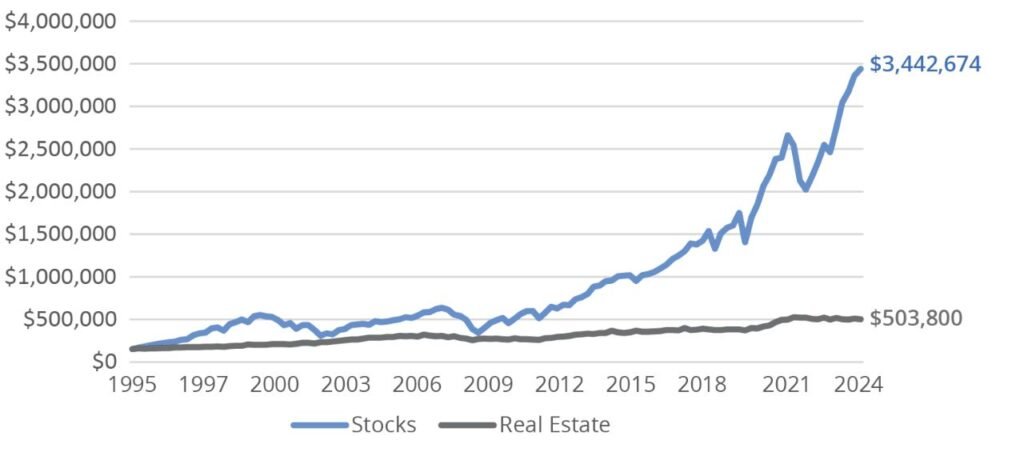
The two types of assets have generated a lot of wealth to investors all over the globe but in very different environments. Real estate deals with buying of physical property like houses, apartments or commercial buildings, whereas stock investment deals with buying of shares of publicly traded companies in the stock market.
There is always a discussion between investors on which one is superior. The fact is that every type of investments has these pros, cons, and BEFs that should be considered according to the objectives of the investor, his/her financial background and tolerance to risks. It is possible to learn the major discrepancies between real estate and stocks and make more effective investment choices and create a diversified portfolio.
Introduction to Real Estate Investment
Real estate investment can be described as the acquisition of property to generate a profit. This payback can be in form of rental or property value or both. These residential properties that might be bought by investors include houses and apartments, commercial properties including offices and retail space, or even land.
The cash flow that is generated by rent is one of the greatest attractions of investing in real estate. When the rent is paid on a monthly basis, the property owner is able to use this income to pay costs and make profit. The value of the property also might go up over time and the investors will be able to sell the property at a higher value than they had initially paid.
Leverage is another significant property of real estate investing. Mortgages or loans are commonly used by investors to buy property. This enables them to run a huge property utilizing comparatively low initial investment. Using the example, an investor can purchase a house valued at $200000 by paying a 20 percent down payment and using the remaining amount as a bank loan. In case of property appreciation, the investor gets the appreciation of the entire value of the property and not only the invested amount.
Nonetheless, there is also a lot of responsibility in real estate investment. The property owners have to do the maintenance, repairs, handling of the tenants, taxes, and insurance. Such tasks may take time, effort, and extra expenses.
Stock Market Investment Knowledge
Stock investing is an investment in stocks of companies that are listed on stock exchanges. When investors buy stocks, they become the partial owners of the respective companies and they could get their growth and profitability. The stock returns are mostly in two forms: capital appreciation and dividends.
Capital appreciation process happens when the value of share of a company is rising with time. Indicatively, long term growth has been high among investors who purchased shares of companies listed in the S&P 500 Index many decades ago because most of the companies have grown and tripled their profits.
Another significant issue in stock investment is dividends. A large number of well-established firms share with the shareholders a part of the profits earned by way of regular dividend payout. This will enable investors to make passive income even as they still retain their shares.
Accessibility is one of the largest possibilities of stock investing. The shareholders are able to begin with quite low sums of money and purchase stocks via online brokers. Stocks are also very liquid investments, unlike real estate which can only be sold and bought at a very slow rate.
Liquidity and Flexibility
The concept of liquidity is the ease with which an investment can be converted to cash. Stocks in this group tend to have a decisive edge in comparison to property.
The sale or purchase of stocks may be made within a few seconds during the market hours. The investors just make an order via a brokerage account and the exchange is made practically instantly. This renders stocks very flexible to individuals who might require their money in a short period of time.
On the contrary, real estate is much less liquid. The process of selling a property may require weeks or months. This may include property listing, buyer identification, price negotiation and finalizing of legal paperwork. Due to this fact, real estate is normally viewed as a long-term investment.
Preliminary Requirement Investment
The other significant variance between the real estate and the stocks is the capital needed to begin to invest.
Real estate tends to demand a huge amount of upfront capital. The buyers may require a down payment, closing cost, legal fees, and maintenance or renovation cash. The initial expense may be a lot even when using mortgage finance.
There is a far less cost of entry in stock investing. The investors are able to begin with small sums of money and continually develop their portfolios over time. Some brokerage sites also have an option of investing in a fraction of a share i.e. one is able to invest in a share of a costly stock rather than in a complete share.
This is one of the reasons why the stock market is enticing to new entrants or individuals who lack big sums of money.
Long-Term Wealth Building
Both property and equities have traditionally shown to be formidable instruments to the creation of long-term wealth. The secret of success in either of the investments is patience and persistent plan.
The benefit of the real estate investor is the appreciation of property and the rental income and leverage. Mortgage payments add up with time to give the investor a progressive ownership of the property.
The growth of stocks in the hands of the stock investors is an advantage. Dividend reinvestment and the ability to expand wealth over a long period through increased investments can greatly expand wealth. In the past, long-term returns of broad stock market indexes have been very high.
Due to such advantages, various financial analysts urge investors to maintain the two types of assets in a diversified investment portfolio.
Conclusion
There is no definite answer concerning the real estate vs. stocks debate. The two options of investments have their own benefits and risks. Real estate is a tangible asset, rental, and leveraged opportunity with greater capital requirements and management needs. Stocks are liquid, accessible, and grow in the long term, but have short-term volatility in the market.
Finally, the superior investment will be subject to the financial ambitions, investment term, and personal preferences of a person. Real estate may be attractive to the investor who wants to have more hands-on control and consistent rental returns whereas the stock market may be attractive to the investor who wants to be flexible and be able to diversify more easily.
In most instances the most logical approach is not using either of the two but the combination between the two. Incorporating both real estate and stocks into a portfolio, one is likely to have a more stable portfolio, income, and long-term growth which will enable investors to create sustainable wealth over time.